- in Guide
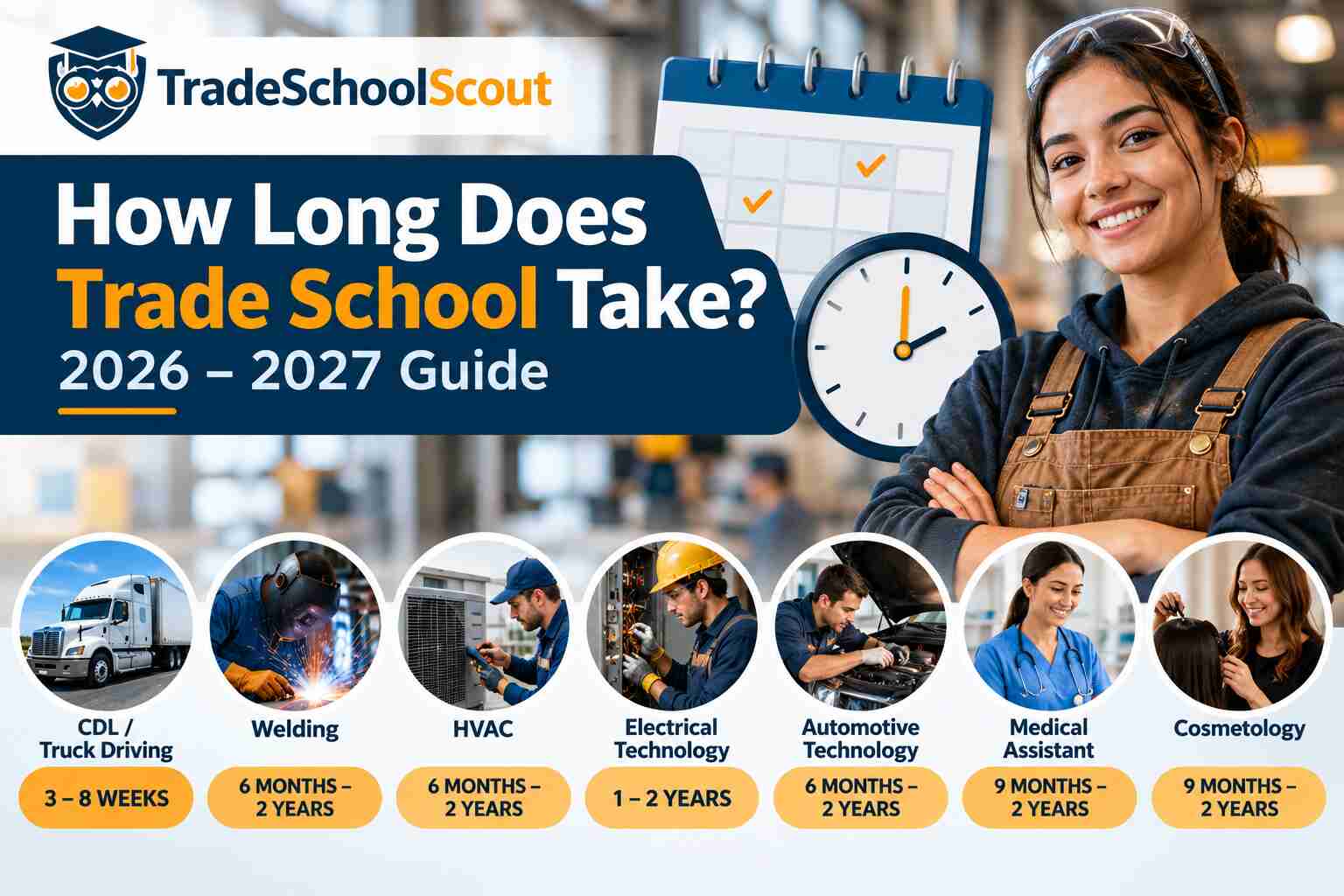
How Long Does Trade School Take?
Trade school can take anywhere from a few weeks to two years or more, depending on the career, credential, program format, and training requirements.
Some students choose short-term certificate programs designed to prepare them for entry-level work quickly. Others complete longer diploma or associate degree programs that provide more extensive classroom and hands-on training.
This guide explains how long different trade school programs typically take, what affects program length, and what to consider when comparing your training options.
How Long Is Trade School?
There is no standard length for trade school because vocational education covers many different occupations and credentials.
A short career certificate might require only several weeks or months of training. A diploma program might take six months to a year, while an associate degree program typically takes around two years of full-time study.
The important distinction is between how long it takes to complete school and how long it takes to become fully qualified for an occupation.
For some careers, completing trade school may be only the first step. You may also need supervised work experience, an apprenticeship, certification, or a state license before performing certain work independently.
Typical Trade School Program Lengths
The following ranges provide a general idea of how long common career-training programs may take. Actual program lengths vary by school, state, schedule, and credential.
| Program | Typical Training Length |
|---|---|
| CDL / Truck Driving | About 3–8 weeks |
| Phlebotomy | About 1–6 months |
| Certified Nursing Assistant (CNA) | Several weeks to several months |
| Medical Assistant | About 9 months–2 years |
| Dental Assistant | About 9 months–2 years |
| Welding | About 6 months–2 years |
| HVAC | About 6 months–2 years |
| Electrical Technology | About 1–2 years for school-based training |
| Automotive Technology | About 6 months–2 years |
| Cosmetology | Often around 9 months–2 years, depending on required training hours |
These are general estimates rather than fixed requirements. Always check the specific program curriculum, required clock or credit hours, and licensing requirements in your state.
Interested in Trade School?
Get information about trade schools, programs, training options, and career opportunities.
Request Information ✓ Free to submit • ✓ No obligationHow Long Does CDL School Take?
Commercial driver’s license training is one of the shorter career-training options.
Many full-time CDL programs can be completed in approximately three to eight weeks, although schedules vary considerably by school.
Part-time or weekend programs may take longer.
Training generally includes classroom instruction and behind-the-wheel preparation. Students must also meet applicable federal and state licensing requirements before receiving a commercial driver’s license.
How Long Does Welding School Take?
Welding training can range from several months to approximately two years depending on the credential and depth of training.
A focused certificate program may prepare students for entry-level welding work relatively quickly, while diploma and associate degree programs can include additional instruction in welding processes, blueprint reading, fabrication, safety, and related technical skills.
How Long Does HVAC School Take?
HVAC training programs commonly take approximately six months to two years.
Shorter certificate programs typically focus on the technical skills needed to enter the field, while longer programs may cover heating, air conditioning, refrigeration, electrical systems, troubleshooting, controls, and other subjects in greater depth.
Depending on the work performed, technicians may also need specific certifications or licenses.
How Long Does Electrician School Take?
School-based electrical technology programs commonly take approximately one to two years, but becoming a licensed electrician can take considerably longer.
Many electricians learn through apprenticeships that combine classroom instruction with paid on-the-job training. These apprenticeships often last several years.
State and local licensing rules vary, so completing an electrical program does not necessarily mean a graduate can immediately work independently as a licensed electrician.
How Long Does Automotive Trade School Take?
Automotive technology programs can range from approximately six months to two years.
Certificate and diploma programs may focus primarily on practical automotive service skills, while associate degree programs generally include additional technical and general education coursework.
Automotive technicians may continue developing specialized skills and earning industry certifications after entering the workforce.
How Long Does Medical Assistant School Take?
Medical assistant programs commonly take approximately nine months to two years.
Certificate or diploma programs are generally shorter, while associate degree programs typically require around two years of full-time study.
Programs may include instruction in clinical procedures, medical terminology, administrative duties, patient care, and other healthcare skills.
How Long Does Cosmetology School Take?
Cosmetology program length depends heavily on state licensing requirements.
States generally require students to complete a specified number of training hours before they can qualify for licensing examinations. As a result, completing cosmetology training may take roughly nine months to two years, depending on the state and whether the student attends full time or part time.
What Determines How Long Trade School Takes?
Several factors can affect how quickly you complete a trade or vocational program.
Type of Career
Some occupations require significantly more technical instruction and hands-on training than others.
CDL training, for example, can often be completed much faster than a comprehensive automotive or electrical technology program.
Type of Credential
The credential you pursue can make a major difference in program length.
- Short-term training: Several weeks to a few months
- Certificate: Often a few months to approximately one year
- Diploma: Often several months to approximately 18 months
- Associate degree: Typically around two years of full-time study
- Apprenticeship: Often several years of combined work and instruction
Full-Time vs. Part-Time Attendance
Full-time students can generally complete their training faster.
Part-time, evening, and weekend programs can be valuable for students who work or have family responsibilities, but they may extend the total time needed to graduate.
Program Schedule
Some career schools offer accelerated schedules with classes throughout the year, while other institutions operate on traditional semesters.
Start dates also matter. Some schools offer new classes frequently, while others may start certain programs only once or twice per year.
Required Hands-On Training
Trade education often requires more than classroom instruction.
Students may need to complete laboratory hours, clinical training, driving practice, shop work, externships, or other supervised practical experience.
State Licensing Requirements
State requirements can significantly affect the total time between beginning training and becoming fully licensed.
This is especially important in occupations such as electrical work, plumbing, cosmetology, and certain healthcare careers.
Trade School vs. Apprenticeship: How Long Do They Take?
Trade school and apprenticeships are different training paths.
Trade school generally provides structured classroom and hands-on education through a school or college. Apprenticeships combine technical instruction with extensive paid on-the-job training.
A trade school program may take several months to two years, while an apprenticeship may last several years.
However, apprentices are generally working and earning wages during their training. For some occupations, completing trade school may also count toward certain apprenticeship or educational requirements, depending on the program and jurisdiction.
Can You Finish Trade School Faster?
Sometimes.
Accelerated programs may allow students to complete training more quickly by attending classes for more hours per week or following a year-round schedule.
Before choosing the shortest program available, make sure it provides enough training for your career goals.
Can You Attend Trade School Part Time?
Many schools offer part-time, evening, or weekend schedules, although availability depends on the program.
These options can make career training more accessible for students who are already working or caring for family members.
The trade-off is that completing the same curriculum part time generally takes longer than attending full time.
Can You Work While Attending Trade School?
Many students do.
Whether it is practical depends on your class schedule, commuting time, study requirements, and the amount of hands-on training involved.
When comparing programs, ask schools whether they offer morning, afternoon, evening, weekend, or hybrid schedules.
Find Training That Fits Your Schedule
Interested in career training? Get information about trade schools, programs, training options, and career opportunities.
Request Information ✓ Free to submit • ✓ No obligationDoes Finishing Trade School Mean You’re Ready to Work?
Not necessarily.
This is an important distinction when researching career programs.
Some occupations allow graduates to begin pursuing entry-level employment shortly after completing training and obtaining any required certification.
Other occupations require additional steps such as:
- Passing a licensing examination
- Completing an apprenticeship
- Accumulating supervised work hours
- Passing certification examinations
- Completing a background check
- Meeting state-specific requirements
Before enrolling, ask the school exactly what credential you will receive and what additional steps are required to work in your chosen occupation.
How to Choose the Right Program Length
The fastest program is not necessarily the best program, and the longest program is not necessarily better.
Instead, compare what you receive for the time and money you invest.
Ask each school:
- How long does the program take for a full-time student?
- Is a part-time schedule available?
- How many classroom and hands-on training hours are included?
- What credential will I earn?
- Does the program prepare me for required certification or licensing exams?
- Will I need an apprenticeship after graduation?
- Are externships or clinical hours required?
- How often do new classes begin?
- What happens if I need to temporarily pause my training?
- What is the total program cost?
Understanding both the training timeline and what happens after graduation can help you compare programs more accurately.
How Long Before You Can Start Earning?
This depends on the career path.
A student completing a short occupational program may be able to pursue entry-level work within months. In apprenticeship-based trades, a person may begin earning wages while still learning the occupation.
Other careers require students to complete school and additional certification or licensing steps before beginning work.
When researching a program, look beyond the graduation date and ask about the entire path from enrollment to employment eligibility.
Frequently Asked Questions
Can you finish trade school in 6 months?
Yes. Some certificate and career-training programs can be completed in six months or less. Program availability and length depend on the occupation, school, schedule, and credential.
Can trade school take only a few weeks?
Yes. Certain short-term programs can take only several weeks. CDL training and some entry-level healthcare training programs are examples of programs that may have relatively short completion times.
What trade takes the shortest time to learn?
There is no single shortest trade because requirements vary by occupation and location. CDL training, CNA training, phlebotomy, and certain short certificate programs can often be completed relatively quickly compared with longer technical programs.
Does trade school take 4 years?
Most certificate, diploma, and associate-level trade school programs take considerably less than four years. However, certain occupations require multi-year apprenticeships or supervised work experience after or alongside classroom training.
Is trade school 2 years?
Some programs are. Associate degree programs typically take around two years of full-time study, while many certificate and diploma programs can be completed sooner.
Is trade school every day?
It depends on the program. Full-time programs may hold classes or hands-on training several days per week, while other schools offer part-time, evening, weekend, or hybrid schedules.
Explore Trade School Programs
Program length is only one part of choosing the right school. Compare training time, tuition, credentials, hands-on experience, schedule options, and career requirements before enrolling.
TradeSchoolScout helps prospective students explore trade schools, training programs, and career education options.
Request Information



Leave a Reply